



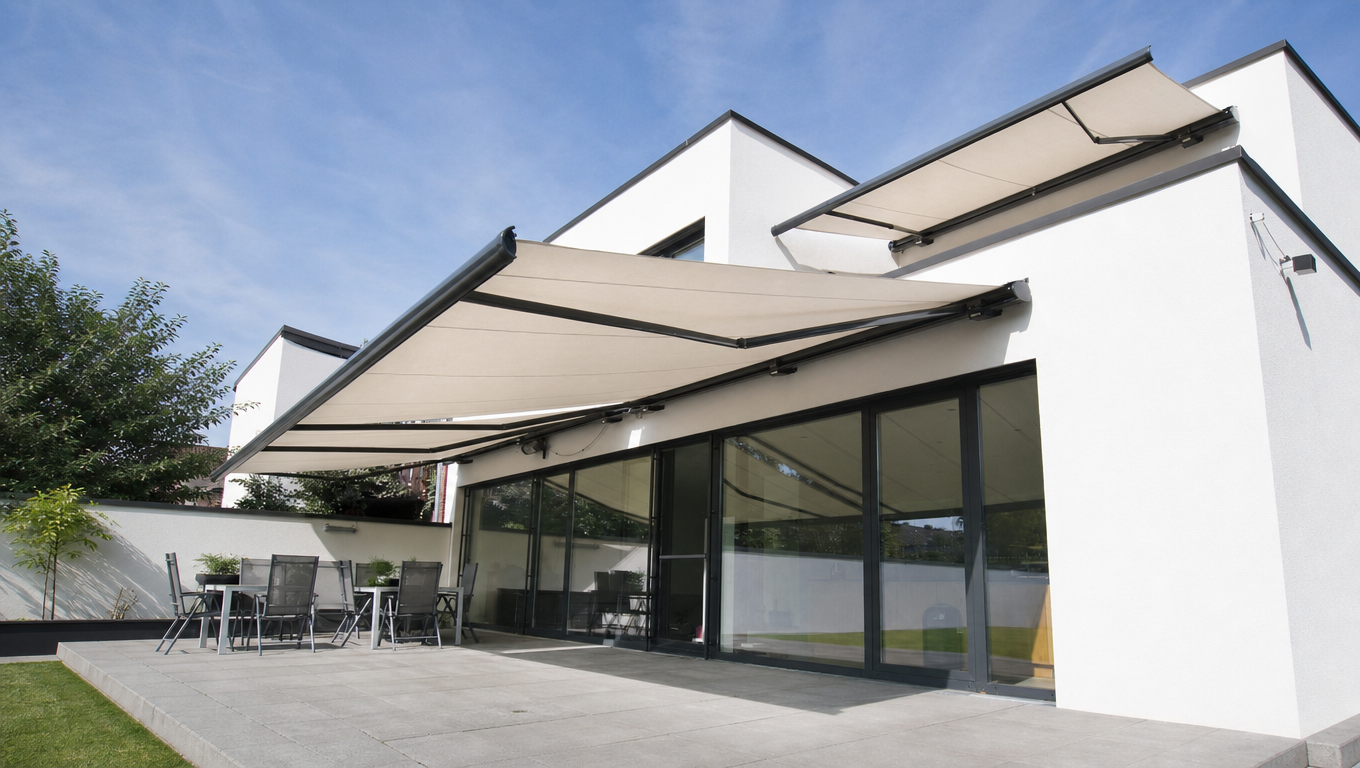
Quick Answer: What Is a Cassette Awning?
A cassette awning is a specialized retractable outdoor shading system that incorporates a protective aluminum housing (the "cassette") to enclose the fabric roll and mechanical arms when retracted. This structural enclosure protects the internal components from UV radiation, precipitation, and debris, ensuring the system reaches its maximum engineered lifespan compared to standard exposed open-roller designs.
- Full-Cassette Awnings: Deliver 100% total enclosure, sealing the fabric, motor, and articulated arms inside a weatherproof aluminum capsule.
- Semi-Cassette Awnings: Provide partial coverage, sheltering the fabric log from the top and front while leaving the arms underneath exposed.
- Open Awnings: Feature no protective casing, relying entirely on existing architectural overhangs for environmental defense.
What Is a Cassette Awning? The Architectural Guide to Retractable Shading Systems
When designing high-end residential patios or commercial outdoor dining spaces, selecting a retractable awning requires evaluating long-term engineering metrics alongside architectural aesthetics. Property owners frequently ask: What is a cassette awning, and is the added structural housing worth the investment? As premium shading specialists, the engineering team at Besitsol knows that understanding the distinct mechanical behaviors of a full-cassette awning, a semi-cassette awning, and a traditional open awning is essential for optimizing property value and outdoor thermal comfort.
Standard open-roller models leave delicate outdoor textiles exposed to localized wind loads, moisture pooling, and continuous UV exposure even when closed. In contrast, a modern cassette retractable awning utilizes a heavy-duty casing to eliminate these precise failure points. By examining verifiable industry lifespan data and mechanical wear cycles, this technical guide outlines how different configurations perform under real-world atmospheric stress.
Mechanical Anatomy: How a Cassette Retractable Awning Operates
To analyze the economic return of a cassette shading system, one must consider the primary depreciation factors of outdoor installations. Traditional non-cassette systems rely on bare roller tubes and dual-spring tension arms that remain exposed 24/7. Environmental data shows that open-roller fabrics often suffer from localized rot, atmospheric soot accumulation, and uneven color fading within the first 3 to 5 years of field exposure.
"According to outdoor shading textile assessments, shielding technical fabrics inside an airtight aluminum housing during non-use periods mitigates early tear strength deterioration by up to 50%."
A precision-engineered cassette system circumvents this environmental degradation. When the automated tubular motor retracts the system, the articulated arms fold inward, pulling the front heavy-duty profile flush against the stationary aluminum wall chassis. This forms a tight mechanical perimeter seal that isolates the fabric roll from moisture, nesting pests, and UV radiation.
Full-Cassette vs. Semi-Cassette vs. Open Awnings: The Three Core Types
Retractable shading infrastructure is categorized into three configurations. Choosing the correct model depends on your building's orientation, microclimate wind speeds, and maintenance expectations.
1. Full-Cassette Retractable Awnings
The full-cassette awning offers the highest level of component integration. When closed, both the technical fabric and the spring-loaded arm assemblies are drawn entirely inside the aluminum shell. This configuration provides a clean, ultra-low-profile footprint that preserves modern minimalist architectural lines on bare external walls.
2. Semi-Cassette / Half-Cassette Awnings
A semi-cassette awning features an integrated top hood and side end-caps that cover the fabric roller log. However, the dual-torsion folding arms remain tucked directly beneath the shelter rather than sealing inside an airtight box. This configuration delivers highly effective vertical weather protection at a balanced mid-tier cost.
3. Open / Non-Cassette Awnings
An open awning leaves the fabric roller and mechanical arm framework fully exposed to the elements. Because it lacks built-in metal housing, its deployment is highly dependent on existing structural protection. It is recommended primarily for installations directly beneath deep roof soffits or recessed structural alcoves.
| Technical Criteria | Full-Cassette Awning | Semi-Cassette Awning | Open Awning System |
|---|---|---|---|
| Enclosure Rating | 100% Fully Sealed Box | Partial (Top & Front Only) | 0% (Fully Exposed) |
| Arm Protection | Complete Internal Enclosure | Exposed Underneath Hood | Fully Exposed |
| Verified Frame Lifespan | 15 – 20 Years (Aluminum) | 12 – 15 Years | 10 – 12 Years |
| Premium Fabric Lifespan | 8 – 12 Years (Max Protected) | 7 – 10 Years | 5 – 8 Years (Exposed) |
Data Support: What Determines Real-World Awning Longevity?
To avoid exaggerated marketing claims, product lifespans must be separated by component material classes. Independent field data indicates that high-quality retractable frameworks outlast their technical fabrics by decades. A structural frame built from 6063-T5 architectural extruded aluminum alloy with a multi-layer powder coating resists rust and structural sagging, achieving a verified physical lifespan of 15 to 20 years with standard care.
However, outdoor fabric performance follows a shorter degradation curve due to continuous climate loading. Solution-dyed acrylic textiles—widely recognized as the industry benchmark for colorfastness and UV stability—typically provide 8 to 12 years of reliable performance before showing noticeable tensile breakdown. Cassette systems maximize this investment by keeping the fabric protected inside the casing during non-use hours, ensuring it consistently reaches the upper limits of its 12-year lifespan.
Looking for Heavy-Duty Overhead Protection?
While cassette awnings offer exceptional flexibility for vertical exterior walls, larger outdoor areas requiring permanent structural wind defense combined with motorized louver control benefit from premium bioclimatic systems. Discover how our engineered aluminum platforms expand your architectural layout possibilities.
Explore Custom Motorized Aluminum Pergolas →Buying Guide: Selecting Your Optimal Cassette Configuration
To simplify the procurement process, cross-reference your specific installation parameters against these three operational factors:
- Exposed Wall Layouts: If your mounting position is a flat facade or a two-story brick wall completely open to the sky, a full-cassette retractable awning is required to protect the system from environmental breakdown.
- Eaves and Overhangs: If your home features an overhanging roofline or a recessed balcony cove that naturally deflects heavy downpours, a semi-cassette awning provides an ideal balance of fabric safety and optimized cost efficiency.
- Smart Sensor Integration: For automated safety, select models equipped with built-in anemometers (wind sensors). These digital modules track sustained wind speeds, automatically sending a command to retract the awning safely inside its protective housing during unexpected storms.
Frequently Asked Questions (Google People Also Ask Target)
What is the main advantage of a full-cassette awning over an open system?
The primary advantage is complete mechanical and textile isolation. A full-cassette awning seals all functional parts inside a weather-tight box when closed. This minimizes dirt accumulation, prevents mold growth on damp fabric layers, and protects internal springs from atmospheric corrosion, lowering long-term maintenance needs.
Can a cassette awning be securely installed on standard residential walls?
Yes. Residential exterior walls are the most common installation surfaces. Using structural expansion anchor bolts, the awning chassis is securely mounted into solid concrete lintels, brickwork, or timber structural framing members, ensuring safe load distribution across the building envelope.
How do you maintain an enclosed cassette awning system?
Maintenance requirements are minimal compared to open systems. Because the aluminum casing shields the fabric when retracted, upkeep is limited to extending the awning twice a year to clear surface dust with a soft brush and washing the fabric with low-pressure water. Always ensure the textile is completely dry before rolling it back into the cassette chamber.
Optimize Your Outdoor Living Environment
Protect your outdoor investments from solar degradation and unpredictable weather patterns. Contact the technical design team at Besitsol today to evaluate your architectural layouts and engineer a custom retractable shading solution.
Explore Besitsol Shading Collections

