
Quick answer
Buy outdoor bamboo blinds by evaluating the full system: material, weave, finish, hardware, mount, exposure, control, care, and replacement plan. Natural bamboo can be a strong design choice for patios, porches, and pergolas, but a natural material claim alone does not prove waterproofing, UV performance, long life, or lower environmental impact.
The eight-part buying checklist
1. Material
Ask what the shade is actually made from: bamboo strips, reed, rattan, wood fiber, grass, synthetic fiber, or a blend. “Natural woven” is a useful design description but not a complete composition statement.
2. Weave and openness
The weave affects daylight, view-through, privacy, airflow, and the visual weight of the opening. Compare a sample in the actual outdoor light rather than judging only from a product-page thumbnail.
3. Exposure
State whether the shade is covered, screened, partially exposed, or fully exposed. Include direct sun, rain, wind-driven rain, sprinkler spray, pool splash, humidity, and coastal air in the brief.
4. Hardware
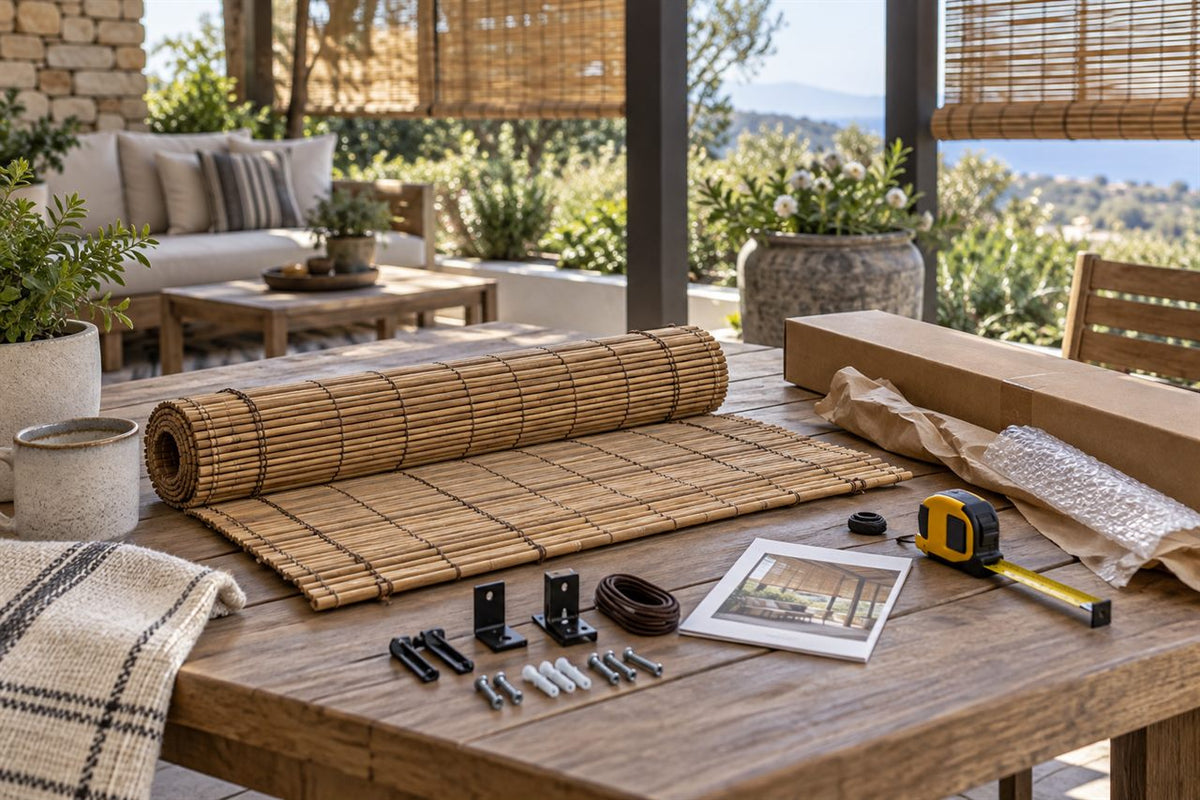
The outdoor shade is not only the visible material. Check the headrail, bottom rail, brackets, fasteners, guides, hold-downs, and any component that touches the structure. Hardware guidance should match the post, wall, beam, or frame where the blind will be installed.
5. Control
Compare the operating method and the plan for strong wind. The control should be practical for the opening, the user, and the shade’s storage position. For US sales, verify current safety and compliance documentation for the final operating system before using safety claims.
6. Care
Ask how to remove dust, pollen, grease, salt, and moisture. Confirm whether the shade should be rolled up or removed before storms and how it should be dried or stored.
7. Privacy and light
Separate daytime privacy, nighttime privacy, glare, view-through, and airflow. A denser weave may help one goal while changing another. Use a liner or second layer only when it is documented for the same outdoor exposure.
8. Replacement and service
Record the material name, color, size, hardware, care instructions, warranty, and replacement-part process. This makes future repairs or additions more manageable, especially when several pergola openings need to match.
For BESITSOL, the current product inputs are a 1-year limited warranty, a typical 15–20 minute installation, and variant-controlled minimum depth and size. Use the live variant selector and final policy wording before publishing a specific depth, maximum combination, or warranty exclusion.
Buying comparison table
| Decision | Good question | Evidence to request |
|---|---|---|
| Material | What is the exact composition? | Specification or material sheet |
| Outdoor use | What exposure is permitted? | Use-zone statement and exclusions |
| Weather | What happens after rain or strong sun? | Care and exposure documentation |
| Wind | When should it be rolled up or removed? | Operating and storage instructions |
| Hardware | What surface and fastener are required? | Installation guide |
| Privacy | What happens in daylight and at night? | Sample, photo conditions, or stated construction |
| Care | How are dust, salt, and spots handled? | Care guide |
| Service | What happens if a part fails? | Warranty and replacement policy |
How to compare natural-material claims
Natural material can reduce reliance on synthetic-looking finishes in a design, but it does not automatically prove a lower total impact. A responsible comparison asks about:
- composition and added coatings;
- packaging and shipping format;
- expected maintenance and replacement frequency;
- repairability of hardware and fabric components;
- whether individual parts can be replaced;
- end-of-life handling;
- warranty and service support.
Avoid unsupported lifecycle numbers, carbon claims, recycled-content claims, or certifications. Ask for the document behind each statement.
What to check before ordering
- [ ] The exact material and weave are documented.
- [ ] The exposure condition is written into the order brief.
- [ ] Hardware and fasteners match the structure.
- [ ] Privacy, light, and airflow expectations are separated.
- [ ] Wind handling and seasonal storage are explained.
- [ ] Cleaning and moisture instructions are available.
- [ ] Warranty, replacement parts, and service contacts are clear.
- [ ] Environmental statements have evidence rather than only natural-material language.
FAQ
What should I look for in outdoor bamboo blinds?
Look for documented material, exposure, hardware, mounting, control, care, privacy, wind, and service information. A strong lifestyle photograph is not a substitute for those details.
Are natural bamboo blinds environmentally friendly?
Natural bamboo can be part of a sustainability discussion, but the material label alone does not prove lower impact. Consider coatings, packaging, durability, repairability, replacement, and end-of-life handling.
Are outdoor bamboo blinds a good choice for a pergola?
They can be when the material and hardware match the pergola’s exposure and the shade has a clear wind and storage plan. Measure each opening and confirm the fixing surface.
Should I buy bamboo shades with a liner outdoors?
Only when the liner is documented for the same outdoor condition and the added weight, roll-up size, care, and hardware requirements are acceptable.
What warranty does the BESITSOL shade include?
The BESITSOL shade includes a 1-year limited warranty. Review the coverage and exclusions before ordering, including installation, moisture, wind, and care requirements.
Next step
Use the BESITSOL Premium Fabric Sample Kit, then measure your patio or pergola opening and review the outdoor exposure guide.
Sources
- S7 — Bamboo Blinds Australia, Outdoor Bamboo Blinds FAQ, product-category and outdoor-use reference; supplier-specific.
- S9 — Home Depot, Outside Mount Bamboo Shades, retail terminology and feature-filter reference.
- S4 — SelectBlinds, Woven Wood Shades Installation Instructions, material and care reference.
- S8 — Arlo Blinds, Can bamboo shades be put outdoor or on a deck?, product-specific exposure caution.


