



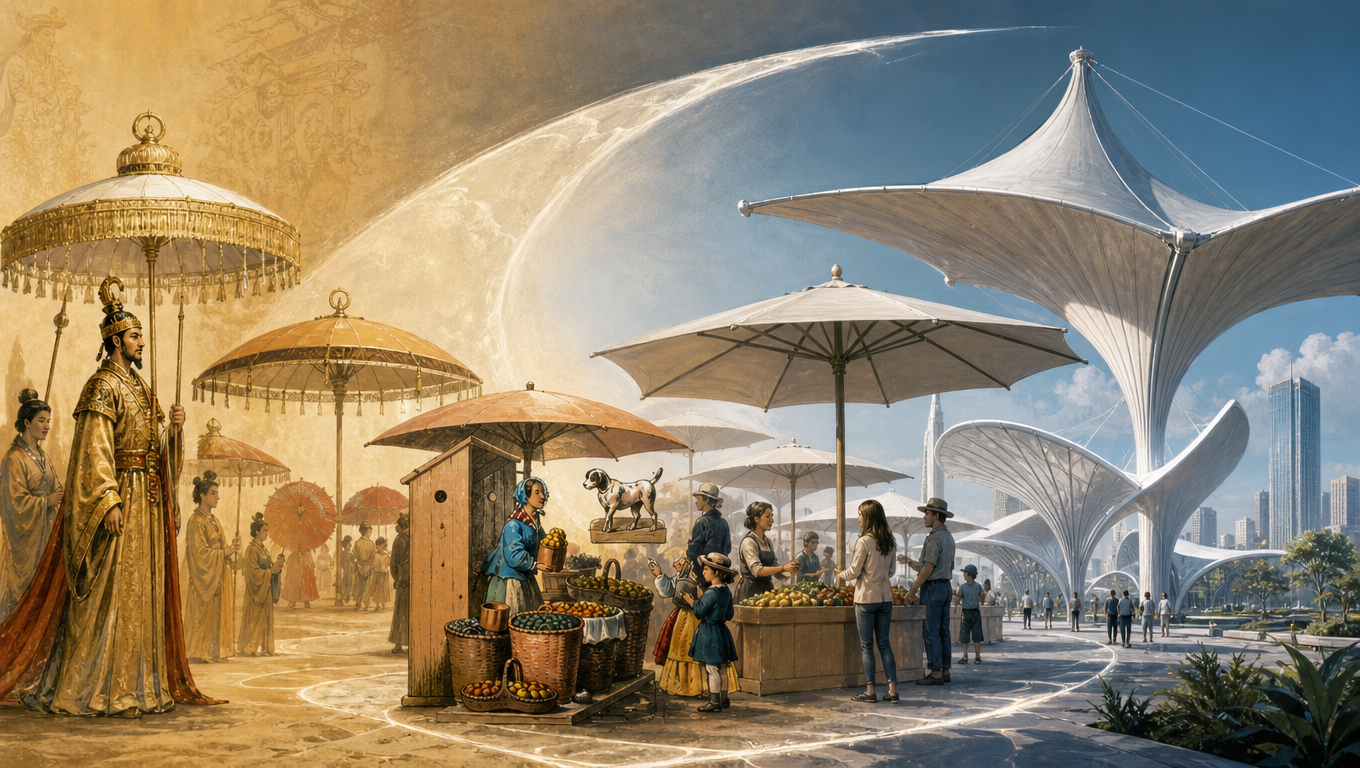
When you sit under a beautifully crafted outdoor umbrella on a luxury resort deck or a private patio, you are enjoying more than just shade—you are experiencing the culmination of over 3,000 years of human history, societal shifts, and architectural innovation. From ancient royal courts to the bustling open-air trading squares of Europe, the humble sunshade has transformed into a critical element of modern outdoor space design.
As outdoor living spaces evolve into true extensions of our homes and commercial venues, understanding the history and architectural capability of the market umbrella helps us better reimagine our modern environments. Today, brands like Besitsol are bridging the gap between historical heritage and cutting-edge engineering, turning standard sun protection into sophisticated space architecture.
Act I: The Origin Story — Why Shade Came Long Before Rain
There is a widespread misconception that umbrellas were invented to shield us from rain. However, etymology tells a completely different story. The word "umbrella" originates from the Latin root "Umbra", which literally translates to "shade" or "shadow." Historically, the battle against the sun predated our need for rain protection by centuries.
In ancient Egypt, Mesopotamia, and imperial China, trees were the only natural source of relief from the scorching sun, but they lacked mobility. To solve this, ancient engineers invented the "portable tree"—the earliest sunshield. In these ancient civilizations, a sunshade was not a consumer product; it was an exclusive, high-value status symbol. Only pharaohs, emperors, and high-ranking royalty were permitted to be shaded by these heavily adorned, silk-and-peacock-feather structures. Holding a sunshade over someone’s head was the ultimate visual declaration of power, proving that the ruler had the authority to control even the elements of nature.
Act II: The Birth of the "Market Umbrella"
As centuries passed, the umbrella migrated via the Silk Road to Greece and Rome, eventually spreading throughout Europe during the Renaissance. However, its transition from a royal luxury to a functional commercial asset occurred during the Agricultural and Industrial Revolutions.
With the rise of urban trading and open-air market squares in England, France, and Italy, merchant vendors faced a massive operational challenge: standing in the blazing sun for hours ruined their fresh produce, dried out fine leathers, and exhausted their customers. To protect their wares and extend trading hours, merchants began erecting large, heavy-duty wooden umbrellas in the center of their stalls. This specific commercial adaptation is exactly how the term "Market Umbrella" was born. These early market umbrellas featured a straight center pole, a sturdy timber frame, and heavy canvas fabric, serving as the foundational blueprint for the commercial shading systems we see today.
Act III: Modern Space Architecture — Reimagining Large Patio Umbrellas
In the 21st century, the market umbrella has broken free from its traditional, rigid constraints. It is no longer just a temporary shield for a street vendor; it has evolved into an essential tool for high-end residential and commercial outdoor space transformation. The shift from heavy timber to marine-grade aluminum, fiberglass, and UV-stabilized acrylic fabrics has revolutionized what a modern shade system can achieve.
One of the greatest architectural leaps in this evolution is the invention of the Cantilever (or Offset) Umbrella. Traditional center-pole umbrellas, while classic, create a physical barrier right in the middle of a social area. Modern patio umbrellas have solved this spatial bottleneck by shifting the structural mast to the side. This offset engineering suspends the massive fabric canopy seamlessly over dining sets, conversational fire pits, or poolside chaise lounges without any obstructing center poles. This clean, continuous visual layout allows homeowners and resort designers to achieve 100% spatial utilization.

Act IV: Spatial Adaptation — Matching Umbrella Shapes to Your Layout
Modern outdoor space renovation relies heavily on geometry. To help you utilize a premium umbrella as an architectural anchor rather than a simple accessory, it is vital to pair the right canopy shape with your specific furniture layout:
| Umbrella Shape | Ideal Spatial Pairings | Visual Vibe & Atmosphere | Space Utilization |
|---|---|---|---|
| Round / Octagonal | Circular conversation pits, bistro tables, hot tubs, single poolside loungers. | Classic, soft, organic, and reminiscent of traditional European beachfront resorts. | ⭐⭐⭐ (Best for targeted focal points) |
| Square | Symmetrical deep-seating sectionals, square dining tables, matching double-lounger sets. | Ultra-modern, sharp, architectural, clean minimalist lines. | ⭐⭐⭐⭐⭐ (Maximum corner-to-corner coverage) |
| Rectangular | Extended 8-12 seat outdoor dining tables, large asymmetrical L-shaped sofas. | Balanced, expansive, perfect for continuous linear outdoor entertainment zones. | ⭐⭐⭐⭐ (Excellent for long structural layouts) |

Act V: Crafting Your Personal Oasis with Besitsol
When selecting a high-end shading system for your property, size matters as much as shape. As a general architectural rule of thumb, your umbrella canopy should extend at least 2 to 3 feet beyond the edge of the furniture it is designed to protect. This ensures complete coverage even as the sun's angle shifts dynamically throughout the day.
From ancient pharaohs asserting their royal dominance to modern designers carving out luxurious open-air sanctuaries, the pursuit of premium shade has remained unchanged. Today, you don't need a royal court to experience this level of lifestyle elevation. By choosing engineered, high-performance market umbrellas, you can instantly turn any open deck, backyard, or restaurant patio into a sophisticated, weather-resistant retreat.
Ready to rewrite the story of your outdoor living space? Explore the masterfully engineered collections at Besitsol Blinds & Shading Systems today, and let our product experts help you map out the perfect custom layout for your next luxury project!


